





Fernandina Beach Paid Parking Referendum: Timeline, Wording, Contract Realities, and What the Outcome Could Mean
As someone who has lived and worked in Fernandina Beach for decades and served as both a city commissioner and mayor, I’ve followed this paid parking debate closely. It touches on core questions of how we make major policy decisions, how citizen initiatives interact with commission actions, and what happens when the two tracks don’t perfectly align. Here is a clear, fact-checked overview of the timeline, the exact wording, the contract with One Parking, and the practical implications — including what could happen if the ordinance is interpreted in a way that leaves the existing downtown paid parking program and contract largely intact.

The Petition and Referendum Wording
The citizen petition created Ordinance 2025-11. Its core language states:
“The City of Fernandina Beach shall not implement paid parking in any designated area without majority approval (50% plus one) vote from a public referendum of registered city voters.”
The full proposed ordinance included standard provisions for scrivener’s corrections, severability, and an effective date. It was often headed as a “Citizen Initiative Ordinance Requiring Voter Approval for Paid Parking in the City of Fernandina Beach.”
Because the City Commission did not adopt it during first reading on October 21, 2025, the measure automatically advanced to the ballot under the city charter. Voters on August 18, 2026 will decide whether to approve this ordinance. No alternative or companion question was added after the commission rejected that idea in April 2026.
Verified Timeline of Key Events
• May 2025: The City Commission issues RFP 2025-05 for paid parking management services.
• Summer 2025: Grassroots petition signature gathering begins at markets, events, and public locations.
• August 16–17, 2025: Organized petition signing events take place across Fernandina Beach.
• August 19, 2025: Commission votes 4–1 to award the contract to One Parking, Inc. and authorize negotiations. Organizers report more than 700 signatures at this meeting.
• Late August 2025: Signature count exceeds 700.
• September 15, 2025: Nassau County Supervisor of Elections certifies 1,722 valid signatures.
• October 21, 2025: Commission considers Ordinance 2025-11; motion to adopt fails. The measure goes to the 2026 ballot.
• November 4, 2025: Commission votes 4–1 to approve final contract terms with One Parking.
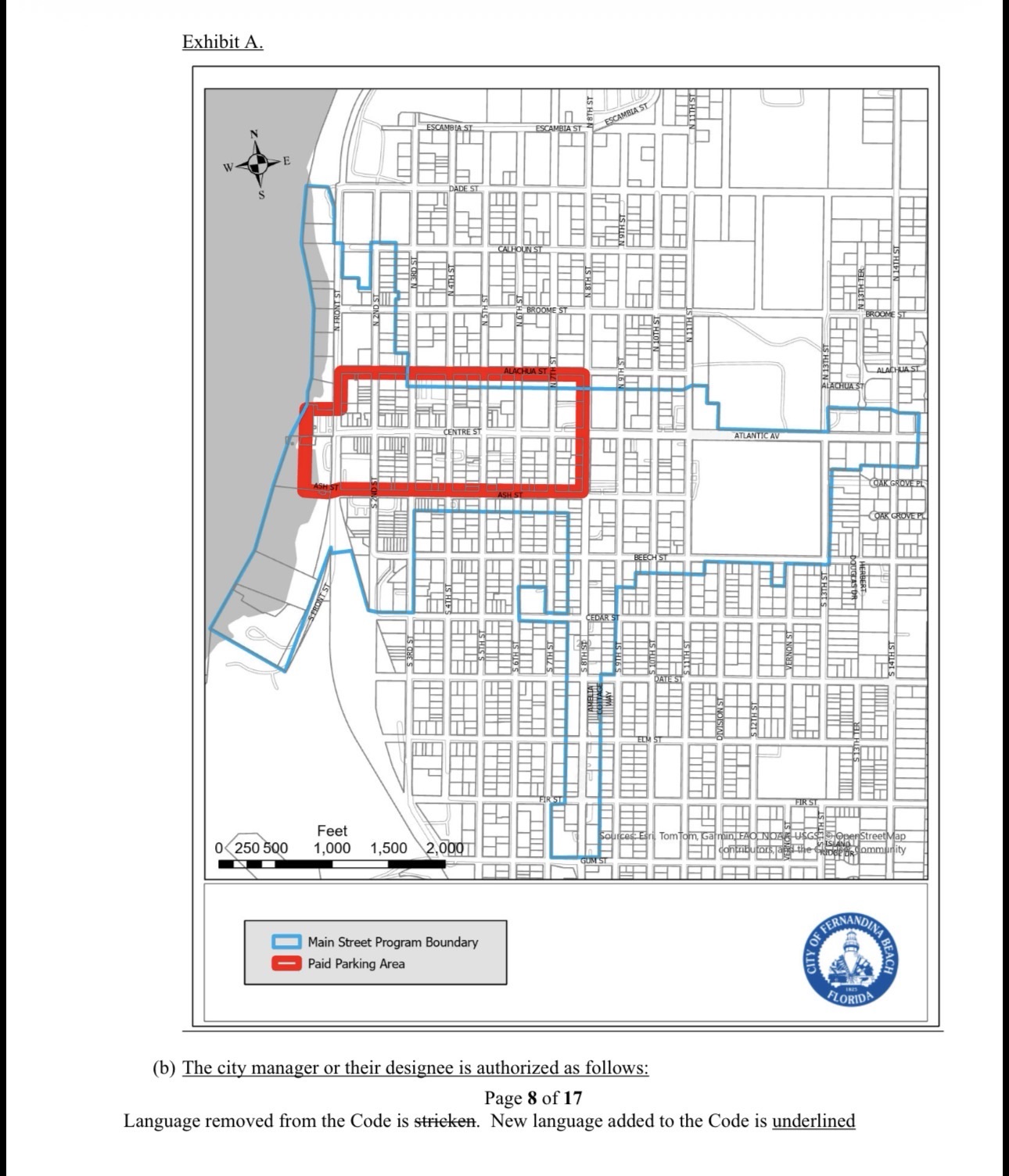
• January 6, 2026: Commission approves Ordinance 2025-13, formally creating the paid parking program.
• Mid-February 2026 (enforcement began around February 16): Paid parking takes effect downtown.
• April 22, 2026: Commission declines to add any companion ballot question.
• August 18, 2026: Referendum on Ordinance 2025-11 is scheduled for the primary ballot.
The Contract with One Parking
One Parking, Inc. was selected to manage enforcement, technology, kiosks, and related services. The agreement includes a two-year initial term with renewal options. First-year costs were capped near $355,925 (plus contingency), with possible annual increases up to 3%.
Termination provisions allow the city to end the contract with 120 days’ notice under normal circumstances or immediately if a citizen-initiated referendum overturns paid parking. If termination occurs within the first year, the city must reimburse unamortized capital costs and limited staff salary expenses. Exact unamortized amounts would depend on actual spending at the time of any exit.
Timing and Wording Implications
The commission selected One Parking and moved toward final contract approval while the petition was actively collecting signatures. By the August 19, 2025 meeting, commissioners were aware of the growing effort. They chose to proceed, citing the need for dedicated revenue to fund infrastructure without tax increases.
The ordinance’s use of “shall not implement” is prospective. Because the program was already operating before the referendum date, approval of the ordinance would clearly restrict future paid parking initiatives or expansions. Its application to the existing program and contract is less clear and would likely require judicial interpretation if the parties disagree after a successful referendum vote.
If the Ordinance Is Interpreted to Leave Existing Paid Parking and the One Parking Contract Intact
This is a realistic possibility that deserves direct discussion. If a court ultimately reads the ordinance as applying only to new or future implementations — and not requiring the dismantling of the program already in operation — several practical outcomes would follow.
The current downtown paid parking system and the contract with One Parking would likely continue under their existing terms. The city would remain obligated to the agreement (subject to its normal termination clauses) and could continue collecting revenue and managing enforcement. One Parking would keep operating its local office and services unless the city later chooses to exit for other reasons or negotiates a different arrangement.
Future changes would face a higher bar. Any significant expansion of paid parking into new areas, major modifications to the program, or new implementations elsewhere in the city would require a separate public referendum and majority voter approval. This creates a two-tier reality: the existing system proceeds, but new paid parking policy becomes much harder to enact without broad resident consent.
Politically and practically, this outcome would likely leave significant dissatisfaction among many residents who signed the petition expecting a stronger check on the current program. It could fuel renewed calls for oversight, additional petitions on related issues, or focused efforts in upcoming commission elections. Recall attempts, which surfaced earlier in the debate, might gain fresh momentum even if they face the same legal hurdles as before.
On the positive side, it would still represent a meaningful expansion of direct democracy. Future commissions would know that major paid parking decisions carry an automatic voter-approval requirement. This could encourage more cautious and transparent planning on both sides of the issue.
Legally, opponents would have limited immediate recourse beyond continued political advocacy and monitoring of compliance. The city would need to ensure that any future paid parking actions clearly follow the new voter-approved rule. Contract exit costs would only come into play if the city independently decides to terminate or renegotiate for budgetary, performance, or policy reasons unrelated to the ordinance interpretation.
In short, the program and contract would remain in place, the city would gain clearer rules for anything new, and the community would continue working through the resulting tensions at the ballot box and in public meetings.
For the most current information on commission agendas, meeting videos, ballot language, or official documents, visit the City of Fernandina Beach website at fbfl.us, the dedicated Parking page at fbfl.us/873/Parking, and city meeting videos at fbfl.us/815/City-Meeting-Videos. Petition and contract details appear in reporting from the Fernandina Observer (fernandinaobserver.com) and the Nassau County Supervisor of Elections. Always verify directly with city and county offices, as facts and interpretations can evolve.
AI Disclaimer: This post is based on publicly available information as of June 2026. It is for informational and discussion purposes and does not constitute legal advice. For official interpretations, consult the Fernandina Beach City Attorney, the Nassau County Supervisor of Elections, or qualified legal counsel. Always verify current status with the appropriate city and county offices.