








2026 Florida Governor Race: Latest Polling Snapshot and Candidate Breakdown
**2026 Florida Governor Race: Latest Polling Snapshot and Candidate Breakdown**

With the Republican primary just a month away and the general election looming, …and recent polling shows Byron Donalds in a dominant position on the GOP side while the Democratic contest has largely consolidated around David Jolly as the clear frontrunner. Here’s a clear-eyed look at the numbers and what they mean for Florida voters.
### Republican Primary Polling
The GOP field features U.S. Rep. Byron Donalds (Trump-endorsed), Lt. Gov. Jay Collins, James Fishback, and former House Speaker Paul Renner. Public surveys consistently show Donalds with a commanding lead that has widened in recent weeks.
**Latest public poll — Tyson Group (July 8–11, 2026, 600 likely Republican primary voters):**
– Byron Donalds: **48%**
– Jay Collins: **9%**
– James Fishback: **8%**
– Paul Renner: **4%**
– Someone else: **4%**
– Undecided: **26%**
Pollster Ryan Tyson noted Donalds’ support climbs even higher among high-propensity voters (older voters, MAGA identifiers, vote-by-mail participants) and called him “for all practical purposes, the Republican nominee.” The lead is described as one of the largest in a modern open Florida GOP gubernatorial primary.
**Recent trend lines:**
– Associated Industries of Florida (June 2026): Donalds 54%, Fishback 8%, Collins 5%, Renner 2%.
– Public Sentiment Institute (late June): Donalds 32%, Fishback 32% (temporary tie in that survey).
– David Jay Wolfson internal poll for Collins campaign (early July): Donalds 37.5%, Collins 20.2%, Fishback 9.6%.
Donalds’ advantages in name ID, fundraising (over $90 million raised), and institutional endorsements have translated into a steadily growing lead heading into the August 18 primary.
### Democratic Primary Polling
Public polling on the Democratic side has been minimal. David Jolly, who left the Republican Party in 2018, served as an Independent and Forward Party member, and switched to Democrat in April 2025 to run for governor, has emerged as the dominant figure and is widely viewed as the likely nominee. He is often appearing with running mate Gwen Graham. No competitive head-to-head Democratic primary polls have gained significant traction in recent months, suggesting the field has largely cleared or Jolly has consolidated support quickly.
### Head-to-Head General Election Polling (Donalds vs. Jolly) Early general election matchups remain limited and preliminary (the Republican primary is still pending). The most recent notable survey:
**Change Research (June 11–14, 2026, Likely Voters —
Democratic-leaning pollster):**
David Jolly **49%** – Byron Donalds **43%** (+6 for Jolly).
Earlier spring polling showed tighter races or small Donalds edges in some surveys. Jolly has shown strength among No Party
Affiliation/independent voters in available data. These numbers are snapshots before a consolidated Republican nominee, heavy paid media, and the full general election campaign. Florida’s underlying Republican lean (strong Trump performance in 2024) and Donalds’ expected primary victory give the GOP nominee structural advantages, but the race could tighten depending on turnout and key issues.
### Candidate Backgrounds
**Byron Donalds** (47) brings a finance and banking background (Wells Fargo, credit roles) after earning a finance/marketing degree from Florida State. He served in the Florida House (2016–2020), chairing the Insurance & Banking Subcommittee, then won a U.S. House seat (FL-19) in 2020. A Freedom Caucus member with Trump’s endorsement, he represents Southwest Florida and emphasizes conservative governance.
**David Jolly** (53), a fifth-generation Floridian and attorney, worked as longtime staffer and general counsel for Rep. Bill Young before lobbying and later serving one term as a moderate Republican U.S. Representative (FL-13, 2014–2017). After leaving Congress he became a political pundit and lobbyist. He switched parties multiple times before joining the Democrats in 2025. He positions his “evolving views” as an asset.
### Policy Contrasts
The race offers a sharp contrast on several Florida-defining issues:
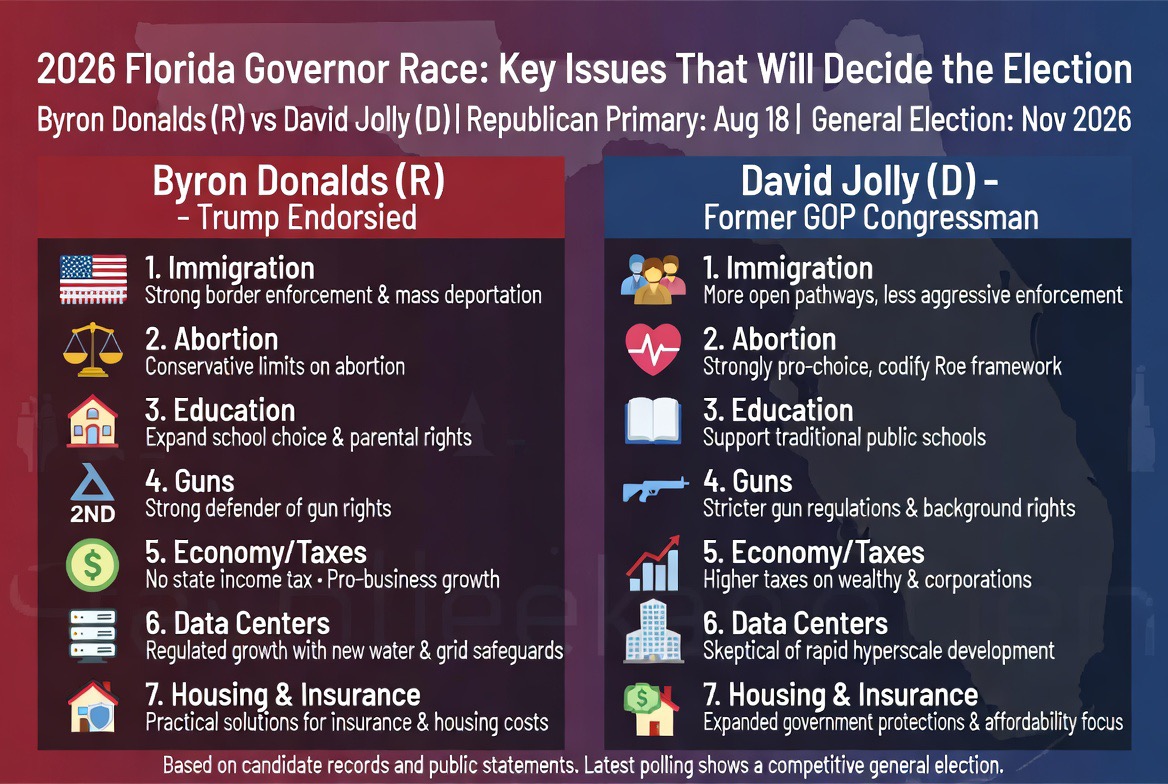
– **Immigration**: Donalds backs strong enforcement, mass deportation, no amnesty, and local-federal partnerships like 287(g). Jolly is portrayed by opponents as more open to pathways and less aggressive enforcement.
– **Abortion/Reproductive Rights**: Jolly is strongly pro-choice and supports codifying Roe-era frameworks. Donalds faces criticism from some quarters over past comments on abortion policy flexibility; his congressional record aligns more with restrictive conservative positions.
– **Education & School Choice**: Donalds champions school choice, personalized learning (including trades), and parental rights while opposing “woke” curricula. Opponents claim Jolly would roll back choice expansions.
– **Guns**: Donalds is a strong 2nd Amendment supporter. Jolly now advocates stricter measures including licensing, registration, insurance requirements, and assault weapons restrictions.
– **Taxes, Economy & Growth**: Donalds emphasizes preserving Florida’s no-income-tax model, pro-business policies, and agriculture support. Jolly is attacked for favoring higher taxes and expanded services; he stresses affordability and pragmatic governance.
– **Environment & Development**: Both address water quality and resilience, but critics of Donalds point to his support for data centers as risking aquifers and farmland.
**Data Centers**
Many of the earlier objections around water consumption, aquifer impacts, and grid costs have been addressed through recent state-level legislation. SB 484 strengthens local government authority to reject projects, requires aquifer-impact reviews, and emphasizes reclaimed water use. A new cost-allocation law effective July 1, 2026, requires very large users (50 MW+) to pay more directly for the infrastructure their demand creates, protecting residential ratepayers. These updates make a regulated, fact-based approach to data centers — the position Donalds has supported — more aligned with current safeguards than blanket opposition.
### Summary Analysis
Current polling paints a clear picture: **Byron Donalds is the heavy favorite to win the Republican nomination** on August 18 and enter the general election with momentum, name recognition, and resources. **David Jolly** has a plausible path in a general election by consolidating Democrats and performing well with independents, as the June Change Research survey hinted, but he faces an uphill climb in a state that has trended Republican in recent cycles.
The race will likely turn on turnout among key groups (Hispanics, independents, suburban voters), how the candidates handle
Florida-specific pain points like property insurance, housing costs, growth management, and hurricane resilience, and whether national political winds shift. Donalds offers continuity with the low-tax, pro-growth, conservative framework that has defined recent Florida success. Jolly offers a more centrist-to-progressive repositioning with an emphasis on reproductive rights, gun reform, and cross-aisle appeal.
These choices will shape Florida’s future on development pressures, school options, infrastructure, and environmental protection.
This post was prepared with AI assistance for research, fact-checking, and initial drafting.
