


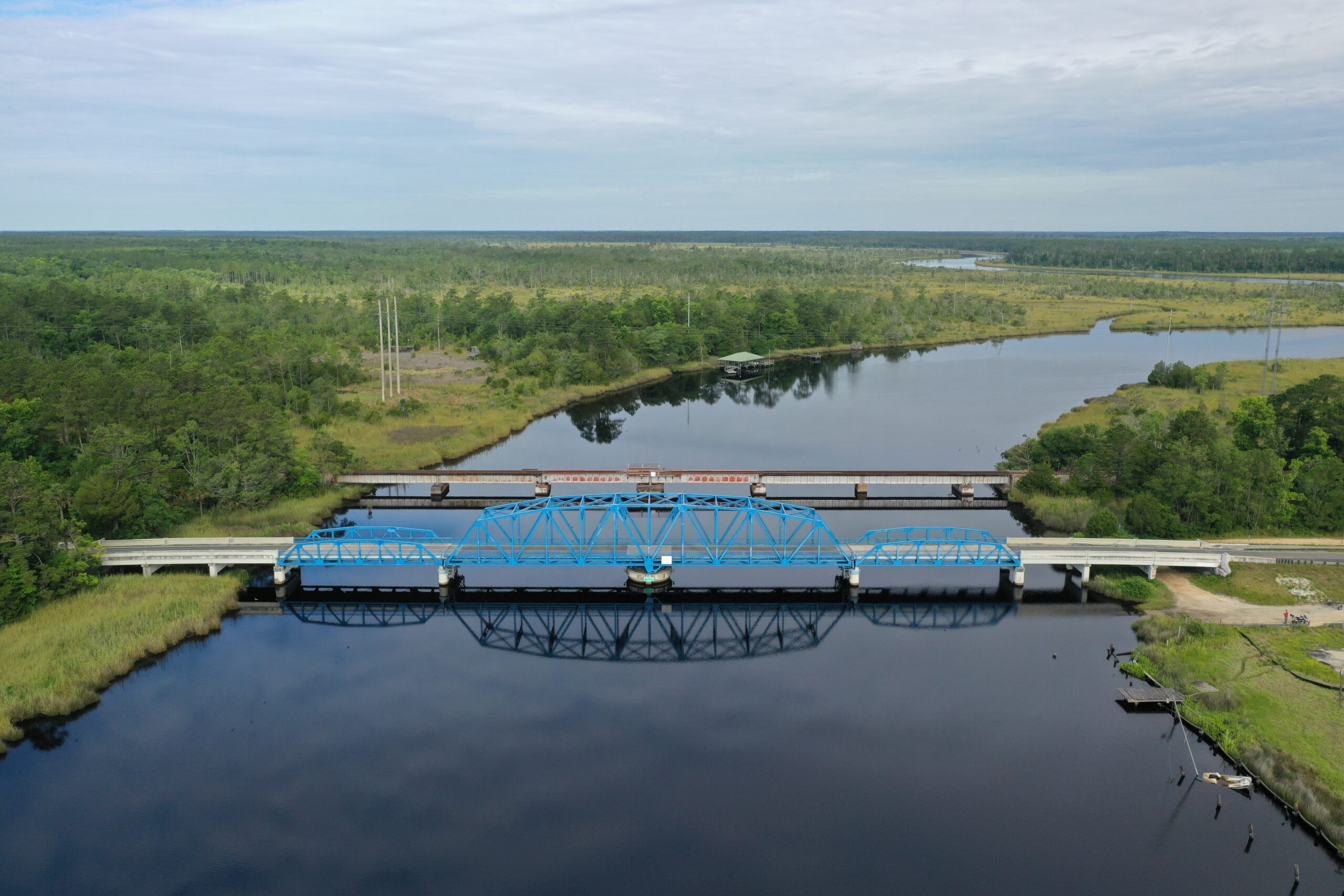
The Blue Bridge: A Historic Swing Span Treasure on the Florida-Georgia Line
If you’ve ever driven U.S. Highway 17 between Yulee, Florida and Kingsland, Georgia, you’ve probably felt that unmistakable mix of nostalgia and mild anxiety as you cross the Blue Bridge over the St. Marys River. Officially the US-17 St. Marys River Bridge, this 1927 structure isn’t just a crossing—it’s a living piece of transportation history that still operates the old-fashioned way.

A Bridge That Changed Coastal Travel
Built between 1926 and 1927 by the Virginia Bridge and Iron Company, the Blue Bridge opened to traffic in February 1927. At the time, it was a game-changer. Before its completion, travelers relied on a ferry to cross the St. Marys River. The new bridge completed the first continuous all-bridge automobile route along the Atlantic Coast Highway (US 17) into Florida.
In an era before Interstate 95, this connection boosted tourism, commerce, and the emerging automobile culture of the Roaring Twenties. Its distinctive blue paint job—chosen for visibility and perhaps a touch of coastal charm—gave it the nickname that locals and travelers still use today.
The Fascinating Hand-Operated Swing Mechanism
What truly sets the Blue Bridge apart is its swing-span design. Unlike modern lift or bascule bridges, this is a through-truss swing bridge that rotates horizontally 90 degrees on a central pivot to open for marine traffic.
Even more remarkable: it remains one of the few hand-operated swing bridges left in Florida. A crew manually cranks the massive center span using a large 15-foot turnkey tool. No fancy electric motors for the swing itself—just good old-fashioned manpower and mechanical ingenuity. When a boat needs to pass, the bridge tenders coordinate the closure of traffic, insert the tool, and literally muscle the bridge open.
This hands-on operation makes the Blue Bridge a rare survivor in an age of automated infrastructure. It’s a testament to early 20th-century engineering that still serves its original purpose nearly 100 years later.
That Narrow, White-Knuckle Feeling
At roughly 19 feet wide for two lanes, the bridge feels noticeably tight—especially when you meet an oncoming semi-truck in the middle. The steel truss structure on both sides frames your view like driving through an industrial cathedral, while the river flows beneath.
Many drivers report gripping the wheel a little tighter as trucks rumble past with minimal clearance. It’s part thrill, part throwback. The narrow width and vintage design remind you that you’re not on a sterile modern highway but on a genuine historic route. Locals often share stories of close calls and the satisfying “I made it” feeling once you reach the other side.
Why the Blue Bridge Still Matters
In a world of widening highways and concrete mega-bridges, the Blue Bridge stands as a charming anachronism. It’s listed on historic registers and draws bridge enthusiasts, history buffs, and road-trippers who deliberately choose US 17 over the faster I-95 parallel route.
If you’re planning a coastal drive through Nassau County, Florida or Camden County, Georgia, make time for this crossing. Slow down, appreciate the engineering, and maybe wave to the bridge tenders. It’s a small but meaningful connection to how we traveled before everything became about speed and scale.
