The 1810 Fernandina Map: The Birth Certificate of a Spanish Colonial Port
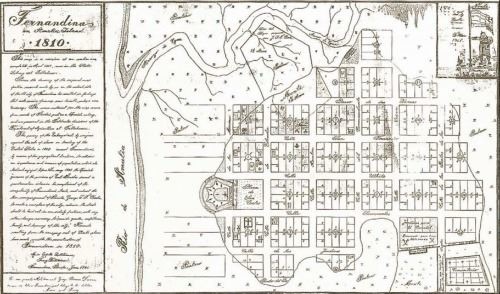
If you’ve ever walked the quiet streets of Old Town Fernandina and wondered why they feel different from anywhere else on Amelia Island — more deliberate, more geometric, more historic — the answer lies in a single document. It’s the 1810–1811 plat of Fernandina, drafted by George J. F. Clarke, Surveyor General of Spanish East Florida.
This map, with its elegant script and perfectly ordered grid, is more than a survey. It’s the founding blueprint for a new Spanish town at the northern tip of Amelia Island, created at a moment when Florida’s future ownership was still an open question and global powers were jockeying for control of the southeast coast.

A Planned Town With a Purpose
Clarke’s written dedication, reproduced on the original map, makes the intentions crystal clear. Fernandina wasn’t just surveyed; it was engineered for long-term success:
Health and elevation were key. Clarke emphasized that the ground was high, the air was healthy, and the streets were laid out to promote good drainage and livability. Regularity and order defined the town plan. Wide streets, rectangular blocks, and public squares mirrored the principles of the Spanish Laws of the Indies — one of the earliest urban planning codes in the world. Beauty and ornament mattered, too. Clarke believed the design itself would attract settlers and commerce.
Even today, the original grid of Old Town remains one of only two surviving Spanish colonial town plans in the United States that follow this design tradition. That alone makes Fernandina historically exceptional.
Why This Location Mattered So Much
In 1810, Spain was losing its grip on Florida, and outside powers — especially the United States — were increasingly interested in the region. Establishing Fernandina was a strategic move.
Clarke spells out the advantages:
A naturally protected deep-water harbor. Immediate access to the interior through the St. Marys River and the surrounding marsh channels. A position ideal for trade, customs collection, and military oversight.
Spanish officials wanted a thriving port that could anchor their presence on the Atlantic side of East Florida. Fernandina was meant to be that anchor — the commercial “emporium” of the province.
A Name With Political Weight
Calling the new town “Fernandina” was not a casual gesture. It honored King Ferdinand VII, then under heavy pressure during the Napoleonic upheavals in Europe. Naming a town after the monarch reinforced Spain’s claim to the region at a time when its authority was anything but secure.
Within a decade, Amelia Island would become a magnet for rebels, smugglers, privateers, and filibusters. But in 1810, the Spanish Crown was still trying to strengthen its hold. This map represents that effort.
The Text from Clarke’s Original Dedication
This is a clean, accurate reconstruction of the text block printed on the left side of the historic map:
Fernandina
on Amelia Island
1810
“This town is situated at the northern extremity of Amelia Island, an island which the Indians called Napoyca.
Under the authority of His Excellency the Governor, this site has been selected and surveyed for the establishment of a new town, the natural advantages of which render it superior to any other on the coast of East Florida. Its excellent harbor, sheltered anchorage, and the immediate access it affords to the interior by the rivers which empty into the sound, must in time render it the emporium of the commerce of this province.
The plan here exhibited is designed to promote health, convenience, and ornament. The lots are laid out with regularity; the streets are of ample width; and public squares are interspersed for the benefit of the inhabitants. The elevated position of the ground and the salubrity of the air promise a settlement of great comfort and prosperity.
The name Fernandina is given in honor of His Catholic Majesty Ferdinand VII, our sovereign.
Fernandina, in East Florida,
December 1810.
By order of
Don Enrique White,
Governor.”
(Often signed: “G. J. F. Clarke, Surveyor General of East Florida.”)
Why This Map Still Matters Today
This isn’t just an artifact for collectors or historians. It still shapes the living city:
Old Town’s layout follows Clarke’s grid almost exactly. The central plazas and wide streets reflect his original vision. The placement of the town on high ground continues to define where development thrives — and where it doesn’t. Fernandina’s early role as a port city grew directly out of the geographic logic Clarke describes.
If Fernandina Beach is a place where history feels unusually present, this map is the reason. It marks the moment the island shifted from a loosely settled frontier to a deliberately planned coastal town — one whose design survives more than 200 years later.
AI Assistance Disclaimer
Portions of this article were prepared with the assistance of AI to enhance clarity, historical synthesis, and readability. All historical interpretations and reconstructions are based on established archival sources and known versions of the Clarke 1811–1812 plat.